Ma'at: A Wellness Branding Project
Overview
As a personal exploration of designing from data, I developed a brand identity for a fictional wellness company called Ma'at. Ma'at symbolizes truth, balance and justice in ancient Egyptian mythology. I built the brand around concept of sleep, stress, where I conceptualized branding elements, mockups and websites for this brand using ideology of Stephanie Posavec's data-driven design philosophy.Background
The Starting Point
The idea was simple: synthesize Stephanie Posavec's body of work into an original brand identity, but not an imitation, a new concept that reflects her philosophy. Posavec is known for translating personal, often intangible experiences, into hand-crafted, human-scaled visual artifacts. Her work lives at the intersection of data and poetry.Design Development
The Logo: A Letter That Lives Two Ways
The logo centers on the letter 'A' transformed into a leaf — a shape that carries both organic warmth and geometric precision. I developed two directions from this core idea:- Organic-Welcoming: Soft curves, earthy tones — approachable and grounded
- Modern-Luxury: Clean lines, elevated palette — aspirational and calm

Data as Visual Language
Taking Posavec's method seriously meant grounding the visual system in actual data. I used Fourier transformation mathematics to convert cortisol graphs — a measurable marker of stress and wakefulness — into polygon forms that symbolize daily biological cycles.The result is a visual motif that isn't decorative in origin: every curve in the system has a numeric basis. This is Posavec's philosophy applied directly — the brand literally encodes the body's rhythms.
Color System
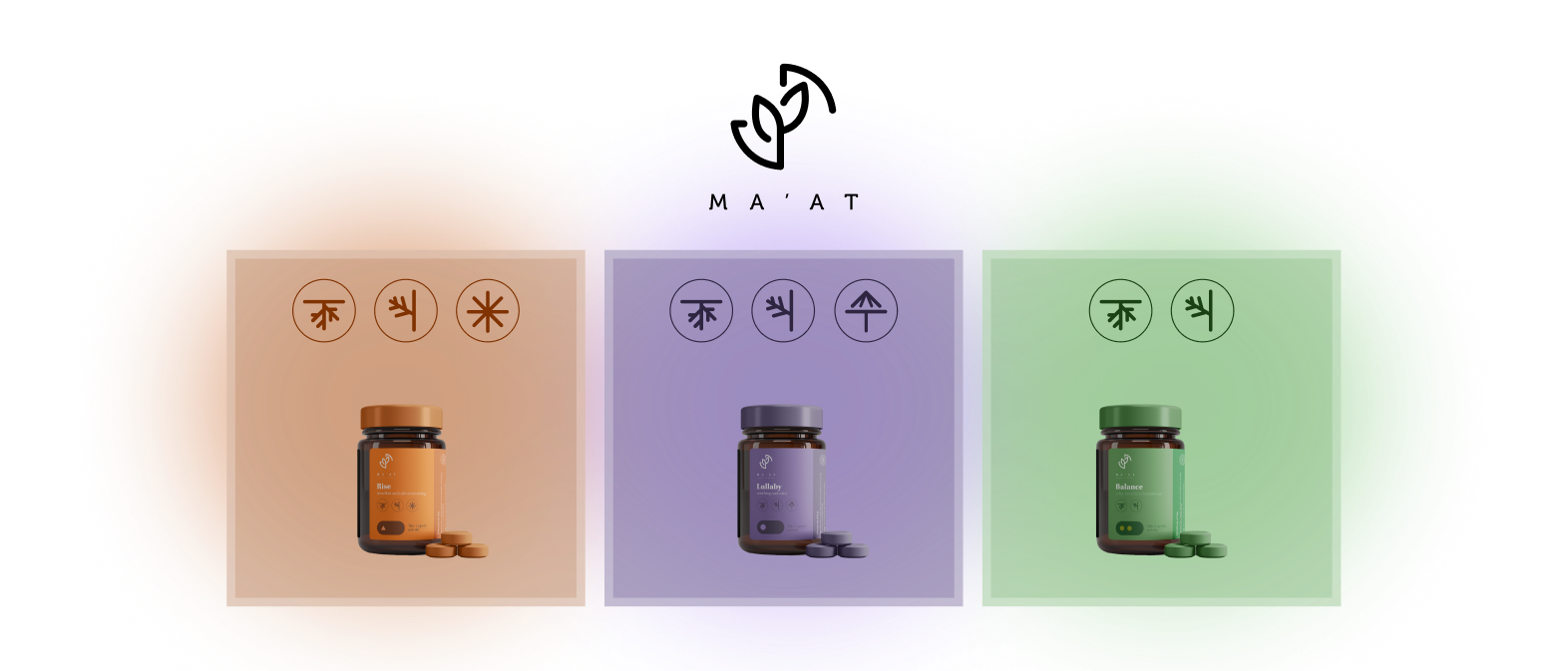
The palette maps to Ma'at's product categories, each grounded in a phase of the day:- Day products: Warm, energizing tones tied to wakefulness and cortisol peaks
- Night products: Deep, cool tones representing rest and melatonin cycles
- All-day products: A bridge palette that transitions fluidly between the two

Design System
The system includes a full typography scale, spacing guidelines, and component definitions — structured to scale consistently across web, mobile, and physical packaging.


